Knowledge Base
How are wind measurements conducted?
7 min read
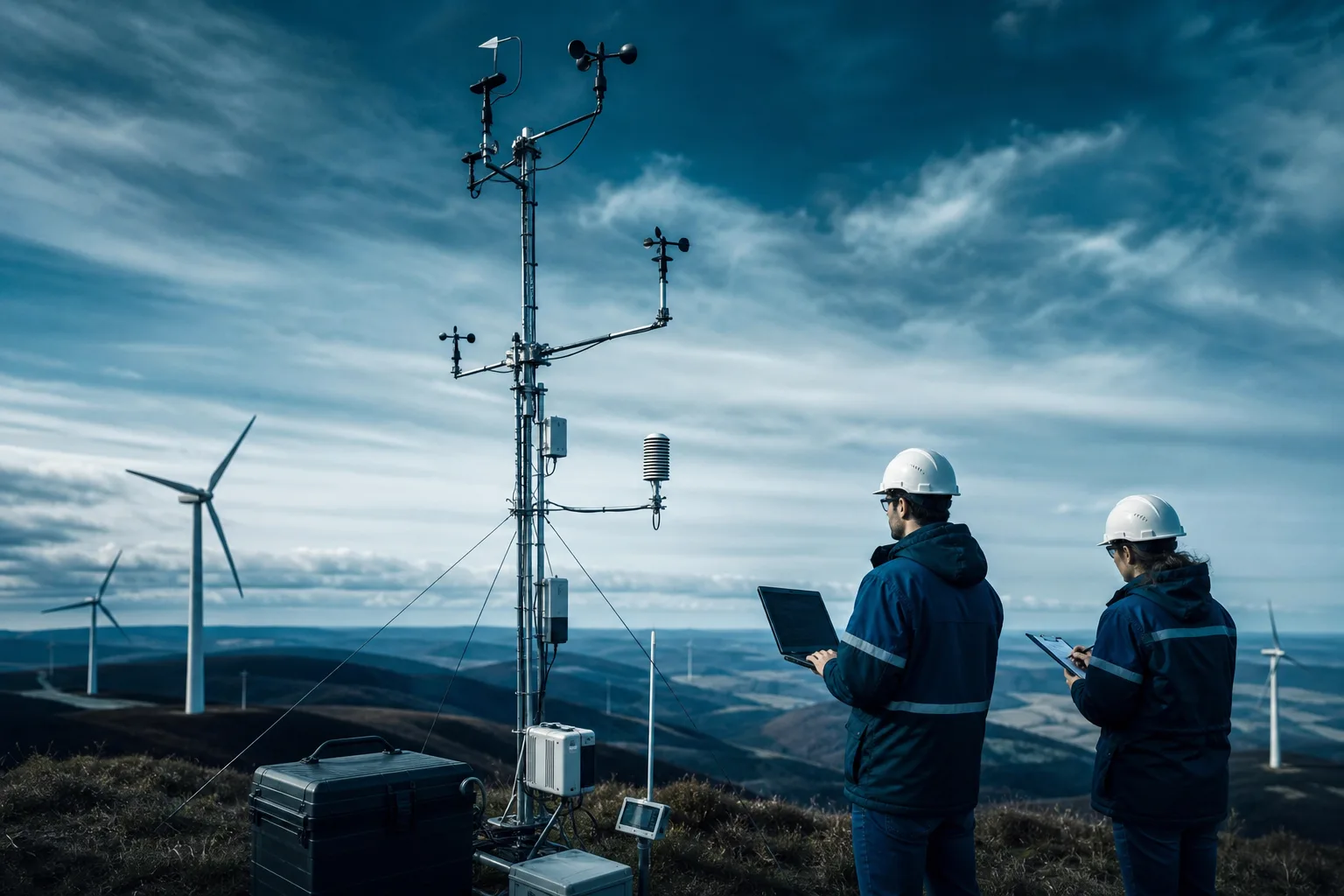
Wind resource assessment is an important aspect of implementing projects in the field of wind energy. The need for a wind measurement campaign is determined by the following factors and reasons:
- the necessity to obtain credit resources, also known as a bankable report (bankable report);
- purchase of new turbines (often manufacturers request wind monitoring data);
- the need to obtain guarantees on electricity production from the turbine manufacturer;
- determining the amount of electrical energy produced by a WEU with high reliability.
Many years of experience in implementing wind energy projects show the importance of having accurate knowledge about wind resources (wind speeds, directions) at the proposed construction site for optimal turbine model selection and reducing uncertainty (errors) in the forecasted amount of electricity produced within the proposed project. In this article, we will try to answer most questions.
Number of meteorological masts
To answer this question, it is necessary to determine the topographical complexity of the landscape. It is permissible to define the topographical complexity of the landscape according to the following criteria:
- the landscape is complex, if the height above sea level at the location of wind measurements and the proposed installation site for wind turbines differs by 50 m or more, or if the area is characterized by orographic features with slopes greater than 0.3 (17°);
- the landscape is simple, if the height above sea level at the location of wind measurements and the proposed installation site for wind turbines differs by less than 50 m;
- the landscape is less complex, if the area features orographic characteristics with slopes less than 0.3 (17°), but the height above sea level at the location of wind measurements and the proposed installation site for wind turbines differs by 50 m and more.

Source photo: Measnet. Evaluation of site-specific wind conditions.
Based on the requirements of Measnet. Evaluation of site-specific wind conditions (hereafter Measnet), when placing a wind measurement complex, it is mandatory to comply with this requirement: all proposed locations for construction of WEU must be within the representativeness range of at least one mast. In accordance with Measnet data, the representativeness of a mast depends on the landscape it is located in and amounts to:
| Landscape type | Representativeness radius (maximum distance from WEU from a mast), km |
|---|---|
| simple | 10 |
| complex | 2 |
For a less complex landscape, the representativeness radius is determined by interpolating values of representativeness radii for simple and complex landscapes. In case of non-uniform roughness on the site that can potentially affect wind measurement results, the representativeness radius (including in directions) is individually determined with consideration of specific features of a particular area.
Therefore, based on the above data, the number of meteorological masts required at a specific construction site for wind installations is determined.
Required height of meteorological masts
In accordance with the requirements of Measnet and FGW Technical Guidelines for Windturbines, the minimum height of wind measurements must be at least 2/3 of the height of the axis of the proposed WEU (hub height). Therefore, for most turbines, masts in a range of heights from 80 to 100 meters are suitable. It is also worth paying attention that the optimal height for conducting wind measurements is the hub height of the WEU intended to be installed. When determining the mast height for conducting wind measurements, it is necessary to take into account various structures in close proximity, because the height of wind measurements should exceed the heights of surrounding vegetation and/or buildings by at least three times (where applicable).
Specification of equipment for a wind measurement complex
Based on international standards and world practices in the field of wind measurements, it is possible to compile a minimum acceptable quantity of equipment installed on a wind measurement complex:
- Three anemometers. One upper (TOP) anemometer, which is installed at the top of the mast. Two additional anemometers (one additional anemometer at a height less than that of TOP anemometer with a minimum distance of 20 meters) and for covering the rotor WEU anemometer additionally installed below on a distance from 10 to 30 meters. Mandatory requirement for anemometers - all installed anemometers must have a calibration certificate in accordance with international standards.
- Two wind vanes. The first wind vane is installed at least 1.5 meters below the TOP anemometer, but within 10% of the hub height of WEU. One additional wind vane is installed below the upper wind vane (minimum distance 20 meters).
- Temperature air sensor.
- Atmospheric pressure sensor.
- Humidity sensor.
- Data logger (device for the operational registration of data to perform measurements of meteorological parameters).
- Cabinet control with autonomous power supply.
- Lighting device for the mast at nighttime.
- Power supply source (for example, photovoltaic panels) in case of absence of power lines.
- Precipitation sensor.
- Pyranometer (for determining the intensity of solar radiation).
The typical device for a wind measurement complex is shown below:

Example of a typical device for a wind measurement complex
The recommendations provided by the International Electrotechnical Commission (IEC), the International Energy Agency (IEA), Measnet, and other international standards contain detailed information on minimum technical requirements for anemometers, wind vanes, data recorders, and other equipment used in conducting wind measurements. Also, these documents contain information on proper orientation, installation, and placement of equipment to obtain reliable data that can be used for further calculations.
Remote sensing devices
Currently, remote sensing devices are widely used for measuring wind speed. There are two main types of devices:
- Sodar (Sound Detection And Ranging) - emits and receives sound and determines the wind speed at different heights based on the principle of Doppler shift;
- Lidar (Light Detection and Ranging), which also uses the principle of Doppler shift, but emits and receives light from a laser.

Photo: example of a Lidar installation (source WindGuard)
Remote sensing devices are, in essence, special ground equipment that can measure wind speed at different heights without the need for using a mast. Therefore, using remote sensing devices has some advantages over traditional masts:
- minimal economic and time costs on installation and dismantling;
- ease of equipment maintenance;
- no need for coordination of the construction of a high-rise object*;
- no need to develop project documentation*;
- saving space.
*Note - depends on the country's legislation
Remote sensing technologies are rapidly developing, and although data from these devices have not yet gained widespread use in the construction of ground wind farms (remote sensing devices are widely used for determining offshore potential), it is expected that they will receive more widespread use in the near future.
Share: