Knowledge Base
Vibration diagnostics of wind turbines: the key to reliability and economic efficiency...
6 min read
вибродиагностикаветрогенераторыпредиктивное обслуживаниемониторинг состоянияветроэнергетикаЭкоТЭКнадежность
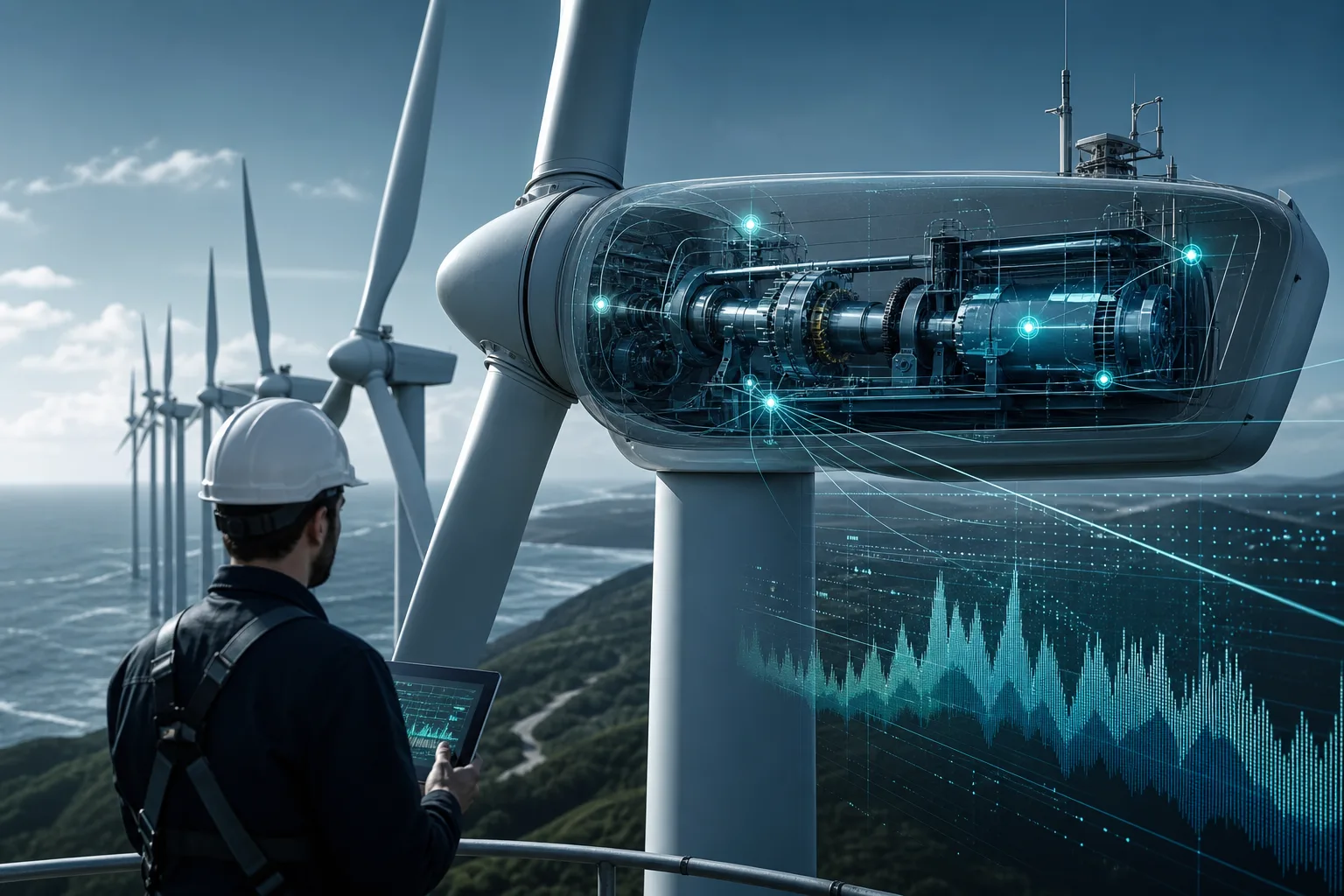
Wind energy is developing rapidly: the capacities of wind turbines are growing, and sites often go offshore or to remote heights. A simple wind generator due to a breakdown can result in significant losses. Here, vibrodiagnostics plays a key role - one of the most effective methods for predictive (preventative) maintenance.
In this article - why is vibrodiagnostics needed, what exactly do they track and what economic benefits it provides to wind farm owners.

What is vibrodiagnostics for wind generators?
Vibrodiagnostics - a method of technical control based on the analysis of vibration signals from working mechanisms. Any rotating machine (wind generator - a set of linked rotating nodes) creates vibration during operation.
In a correct state, this vibration has a stable spectrum («fingerprint»). When a defect appears - cracks, wear, tilt - the nature of vibration changes. Modern condition monitoring systems (CMS) capture these changes well before reaching critical failure stage.
Analogy: like a stethoscope for a doctor. An experienced diagnostician can assess the condition of a gearbox or generator by sound and vibration, without disassembling the unit.
Key nodes under control
A wind generator is a high-tech complex. Vibrodiagnostics focuses on the most heavily loaded components:
Main gearbox. One of the most expensive and critical nodes. By vibration, wear of gear teeth, bearing defects, lubrication problems are detected.
Generator. Allows to detect electrical asymmetry, issues with winding or mechanical imbalance of rotor.
Main bearing (main bearing). Holds the rotor; its failure stops the turbine.
Blades and rotor. Vibration helps to identify blade imbalances (contamination, icing, damage), which reduces efficiency and increases load on the tower.
Tower and nacelle. Monitoring of own natural frequencies of vibrations reduces the risk of metal fatigue damage.

Comprehensive diagnostics of wind installations is one of the directions of work for "EcoTEK": vibrodiagnostics of industrial equipment and WEU.
Five main advantages
Implementing vibration monitoring transitions maintenance from reactive («fix when broken») to predictive («repair before critical failure»).
1. Reduction of OPEX. Emergency repairs are often significantly more expensive than planned ones. Vibrodiagnostics allows for ordering parts in advance and coordinating the arrival of a crew without urgent markup and downtime.
2. Minimization of Downtimes. When there is wind, every minute of downtime means lost production. Planning repairs during periods of weak wind or low energy demand is especially important; for offshore it's critical - the cost of sending a vessel to a turbine is high - going "blindly" is not profitable.
3. Extension of Service Life. Working with growing defects increases dynamic loads. Timely balancing or replacing a node reduces load on adjacent components and helps achieve the projected or longer service life (often 20–25 years).
4. Safety. Fewer sudden accidents mean fewer emergency lifts in bad weather.
5. Guarantee Disputes. A history of vibrodiagnostics is an objective argument when interacting with OEMs.

Service Support: technical maintenance of wind farms, if necessary - Wind Turbine Repair.
Technologies and Trends
Modern vibrodiagnostics is shifting from infrequent onsite measurements to continuous online monitoring. Integration with SCADA - data from vibration sensors combined with energy production and meteorological parameters in the control center. AI and ML - estimation of remaining useful life (RUL), reduction of false alarms. Remote diagnostics - experts analyze turbines in different regions without having to go on site each time.

Challenges of Implementation
Environment: Sensors must withstand vibration, temperature fluctuations, humidity and EMI interference. Data Volume: Continuous recording requires filtering and processing on site (edge). Frames: There is a need for engineers who can interpret spectra specifically for wind turbines.

Conclusion
Vibrodiagnostics for large capacity turbines has become an industry standard: in order to reduce the price of electricity and meet increasing reliability requirements, ignoring "the health" of mechanisms is not possible. Investments in vibromonitoring often pay off through prevention of one major accident - this is an asset management tool and a stable cash flow from the wind farm for years ahead.
A healthy WTG works predictably by vibration; the task of diagnostics is to hear problem before it becomes critical.
Share: