Knowledge Base
Top 10 Wind Turbine Models
6 min read
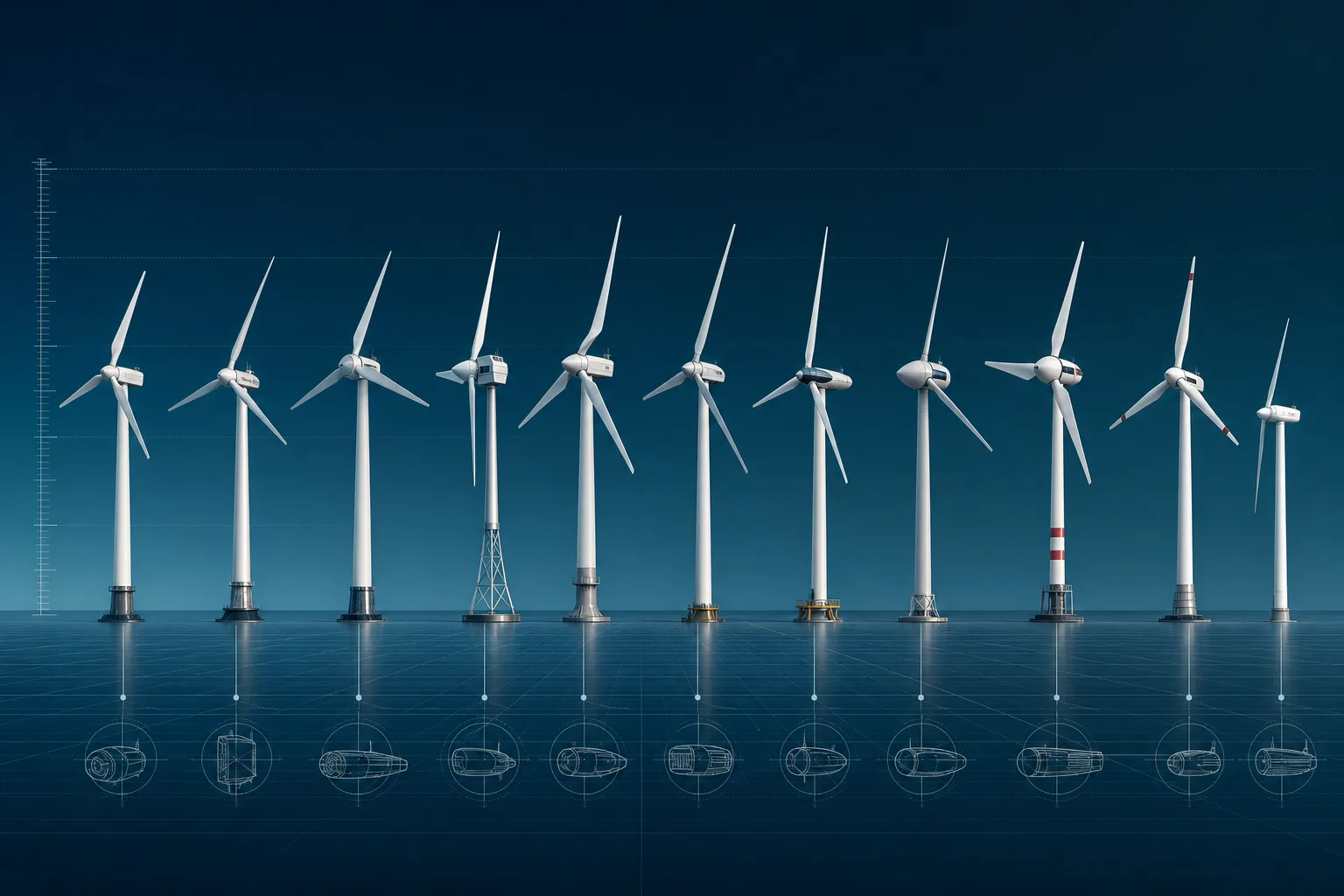
The Global Wind Energy Council has shared fresh statistics on global wind turbine deliveries. Over the past year, a total of 23,098 turbines were installed worldwide - an impressive result for the global industry! Ten leading models accounted for 21% of the market (4,881 installations). This vividly illustrates not only fierce competition but also abrupt technological development and manufacturers' flexibility.
Top 10 Wind Energy Units.
Here is how deliveries were distributed among the key players:
1. Goldwind GW191-5000H — 883 turbines — a high-performance model with a large rotor, optimized for offshore wind energy applications.
2. Vestas V150-4.5 — 836 — a reliable onshore wind turbine unit of medium power with improved aerodynamics.
3. Envision Energy EN-200/6.25 — 462 — a powerful model with large blade area, designed for maximum performance at high altitudes.
4. Mingyang Smart MySE5.0-193 — 441 — an intelligent turbine with advanced control system and adaptive blades.
5. Vestas V162-6.xEnVentus — 404 — an innovative model with increased power and improved design for efficiency enhancement.
6. Windey WD200-6250 — 391 — a low-noise turbine suitable for densely populated areas.
7. Envision Energy EN-156/3.3 — 384 — a compact and efficient model for regions with moderate wind potential.
8. Goldwind GW204-5600H — 371 — a turbine with high resilience to extreme weather conditions.
9. GE Vernova 2.8-127 — 369 — a versatile model with an optimized rotor design for a wide range of climatic conditions.
10. Envision Energy EN-200/5.0 — 340 — a powerful and reliable turbine, adapted for long-term operation in various regions.
Dominance and movement on the market.
Regional specifics are clearly expressed — out of the top 10 models selected based on official data on global installed capacity, seven were produced by Chinese companies. Chinese giants such as Goldwind, Envision Energy, Mingyang and Windey have demonstrated strong expansion and technological leaps. Danish Vestas in the list holds two positions, continuing to strengthen its reputation as a global expert and competitor. GE Vernova from the USA also made it into the top 10, indicating that the company maintains an international status. But on the global stage, Chinese companies operate by the principle of "maximum speed - maximum flexibility". They quickly respond to demand, rapidly launch new models, and most importantly, solve the problem of maximum efficiency in regions with less favorable wind conditions. Thus, Goldwind became the largest supplier of wind turbines in Latin America, installing more than 6 GW of capacities, while Envision Energy implemented projects with a total capacity of over 3 GW in Europe and North America. Goldwind, Envision Energy, and others have secured themselves not only at home but also on the largest foreign markets.
Why is Goldwind again number one?
The flagship of Goldwind - model GW191-5000H - topped the ranking with a delivery of 883 units. Highest reliability is ensured by two TRB bearings and intelligent sensor equipment (LiDAR, gap sensors for blades). Engineers at Goldwind meticulously refined the tower base, reinforcing it using new composite materials to increase resistance to vibrations, as well as implementing adaptive control algorithms that allow optimizing blade pitch angle depending on changing weather conditions. These innovative solutions have increased safety and allowed for maximum electricity production even in challenging weather conditions. The award from Windpower Monthly and the status of "Best Onshore Wind Turbine" in 2023 became a natural reflection of the company's innovative capabilities
.
Vestas: in the vanguard of European tradition.
Two Vestas flagships, the V150-4.5 (power of 4.5 MW, rotor diameter of 150 m with 836 installations) and the V162-6.xEnVentus (approximately 6 MW power, rotor diameter of 162 m with 404 installations), are still in operation. The V150-4.5 is designed for low wind speeds, combining aerodynamic expertise with smart management, making it an optimal choice for regions with moderate wind potential and the need for high efficiency at weak winds. On the other hand, the V162-6.xEnVentus represents a hybrid solution with a compromise between reliability, innovation, and operational economy, featuring greater power and rotor size, which is ideal for areas with high and variable wind speeds, providing increased electricity generation. Thus, the V150-4.5 wins in conditions of low wind speed thanks to its adaptability and manageability, while the V162-6.xEnVentus is better suited for large-scale projects with a high potential for wind, where reliability and operational economy are important. Thanks to this, Vestas maintains a stable market share in Europe, America, and Asia.

Envision Energy: versatility and global success.
Immediately, three Envision Energy models made it to the top: EN-200/6.25, EN-156/3.3, and EN-200/5.0. The total volume of deliveries is 1186 turbines! The hit model EN-156/3.3 made a real revolution on the Indian market thanks to its low starting threshold (3 m/s) and adaptability to weak winds - in 2024 alone, more than 5 GW were ordered for India. Model EN-200/6.25 is characterized by a power of 6.25 MW, large rotor diameter of 200 meters, and an efficient control system, ensuring high performance even under variable wind conditions. The EN-200/5.0 model has a power of 5.0 MW and optimized aerodynamic design, increasing energy generation and reducing structural load. These technical features highlight the advantages of Envision Energy models in diverse climatic conditions and contribute to their high popularity on the global market. The EN-200/6.25 and EN-200/5.0 belong to the Model X platform: modular construction, unified components, flexible adaptation depending on the region. Tower heights range from 100 to 170 meters, distributed according to wind situation needs. The EN-200/6.25 model ensures maximum power of 6.25 MW, while the EN-200/5.0 provides a power of 5 MW at an efficiency index (KIU) of around 42%. Thus, Envision effectively balances between cost, power, and service, guaranteeing reliability for both powerful wind farms and regions with low or medium wind speed.

Why are all talking about low wind speed?
The trend of recent years is to bet on generators that can work in regions with average and low wind activity. Out of the top 10 models, most are designed for such tasks, while the maximum power reaches up to 6.25 MW (record for Envision EN-200/6.25), and the minimum is 2.8 MW (GE Vernova 2.8-127). More projects are being developed outside traditional wind energy zones, which requires new technological approaches such as using advanced aerodynamic blades with variable pitch for increasing efficiency at low wind speeds, integrating intelligent control systems based on artificial intelligence for optimizing operation in varying conditions, and applying lightweight materials to reduce installation mass and increase reliability. On these developments, world leaders are investing more resources.
What's next?
Competition will push all players - both Chinese and Western - to accelerate the adoption of advanced technologies, seek global strategic alliances, and constantly improve service. Competition and collaboration at the same time are drivers for updating the entire energy sector.
Share: