Knowledge Base
Disadvantages and drawbacks of wind energy technology
11 min read
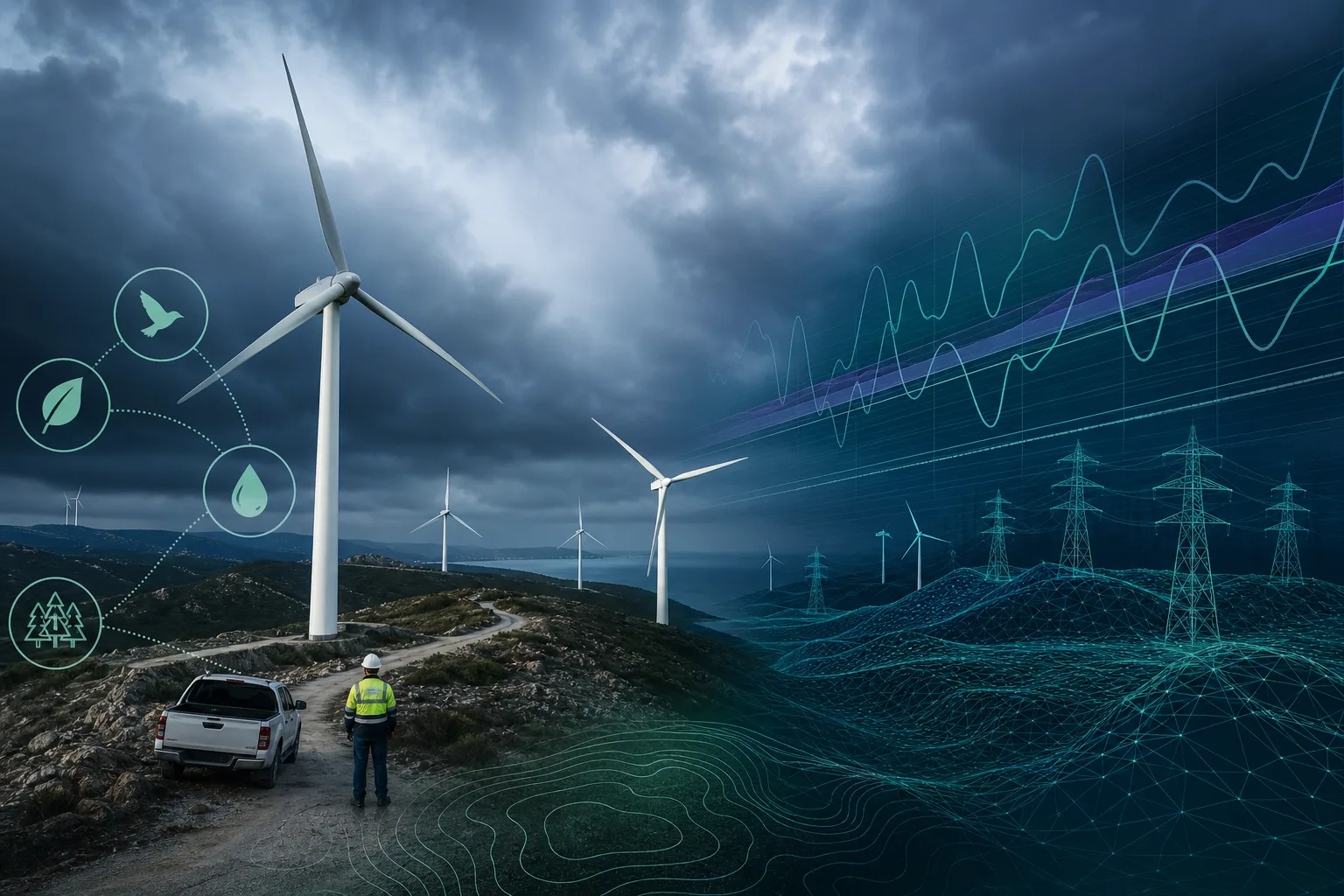
Wind energy is actively developing in many countries around the world as a source of renewable energy. However, despite its environmental advantages, this type of energy has its own drawbacks that must be taken into account when planning energy systems.

1. Instability and dependence on weather conditions.
The main disadvantage of wind energy is the instability of electricity production. The wind does not always blow with constant force and speed, and sometimes it may be completely absent. This leads to the fact that wind power plants (WPP) cannot provide a constant supply of electricity. This creates huge challenges for energy systems that must maintain a balance between electricity production and consumption in real time.
Crisis in Europe 2e11 g.: In the second half of 2021, an anticyclone settled over most of Europe. As a result, wind energy production in Germany fell by 70% compared to the previous year, and in Great Britain - by 80%. The deficit had to be compensated for with sharply rising natural gas and coal prices, which became one of the key factors in the record increase in electricity prices for consumers.
California, USA (2021): In February 2021, a widespread power outage and heating supply failure occurred in the state of Texas due to three strong winter storms. More than 4.5 million homes and businesses were left without electricity. The governor and some other politicians initially declared renewable energy sources as the cause of disconnections, citing frozen wind turbines as an example of their unreliability and solar power plants.
Power Outage on the Iberian Peninsula (2025): On April 28, 2025, a massive power outage occurred on the Iberian Peninsula, affecting Spain, Portugal, Andorra, and part of France, as well as Morocco. At the time of the grid failure, there was a significant surplus of generation—almost one-third more than consumption. Of this production, about 70% came from renewable energy sources (RE), such as solar and wind power plants. The key issue was the lack of inertia in RE compared to traditional power plants; they cannot maintain frequency stability in the grid during sudden fluctuations. After breaking connections with the French energy system, there was an excess of capacity, which led to a rise in frequency. In response, automatic protections were triggered, primarily on objects from RE, causing a sharp transition from surplus to deficit generation. This triggered a chain reaction: thermal and nuclear power plants began emergency shutdowns due to overloads, ultimately leading to the collapse of energy systems.
It is worth noting that further analysis of the causes of power outages showed that renewable energy sources (wind farms) were not the initial causes of grid failures. In most cases, the main causes of power outages were issues in the energy system (for example, voltage fluctuations on 400 kV lines or disconnection of traditional energy sources due to frost in Texas), but at the same time, many reports pay special attention to comprehensive modernization of network infrastructure for using a large volume of RE in networks (such as adjusting equipment to prevent premature shutdowns and improving coordination between generation and load).
2.Noise Pollution.
Wind turbines create noise from the operation of mechanisms in nacelles and vortices created by blades. Wind farms are quite noisy, for example, the maximum level of sound (equivalent or acoustic) for modern installations is in the range of 105-1
At the same time, with the aim of minimizing noise impact on people's lives and health during planning and development stages of wind energy projects, special attention is paid to assessing noise pollution at proposed construction sites. In this study, noise calculations are performed to ensure compliance with legislation within residential areas and other zones, taking into account existing noise pollution and various factors. If the requirements for sanitary norms are not met, it will be impossible to build a wind farm on the chosen site. It should also be noted that most manufacturers have different operating modes aimed at reducing equivalent noise from wind farms, which is used during nighttime operation since acceptable noise levels in most countries differ between day and night times.
For example, the following calculation shows an assessment of noise impact on residential areas when implementing a project at a construction site for wind energy.

It is worth noting that during the implementation of wind energy projects, instrumental measurements of noise levels at wind farm boundaries are often required to confirm calculated values and ensure safe operation for the health and well-being of the population.
3. Geographical location limitation
The efficiency of wind energy strongly depends on geography and climate. Not everywhere is there enough frequent and strong wind to make turbines cost-effective. This makes wind energy suitable only for certain regions.
Example: Over 60% of all wind turbines in China are located on the northwest and northern coasts, as well as large offshore installations along the eastern seaboard due to excellent wind resources. High energy consumption is concentrated in the eastern coastal provinces, creating a spatial mismatch between regions producing and consuming electricity. To address this issue, the Chinese government has adopted the "West-East Power Transmission" program (West-East Power Transmission) — a strategic project of China to transfer clean energy (hydroelectric power plants, renewable energy sources) from resource-rich western/northern regions into energy-deficient eastern provinces. Super high voltage direct current lines are used, which allows for the transmission of 60 billion kWh annually.

4. Impact on the environment and biodiversity
Although wind energy is considered eco-friendly, it can have a negative impact on nature. The blades of wind turbines, especially older models, move at high speeds and are dangerous for birds, particularly predatory (eagles, hawks) and migratory species.
Example:
USA, California (Altamont Pass): This is perhaps the most famous example. The wind farm in Altamont Pass, built in the 1980s, is located on the migration route of golden eagles. According to various estimates, hundreds of these rare birds die there every year. The owners were forced to go for an expensive modernization - replacing old turbines with new ones that are higher and less dangerous - to reduce mortality.
Norway, Smøla archipelago: Studies on this island have shown that the population of white-tailed eagles has almost stopped growing within a 500-meter radius from wind turbines. Birds avoid nesting near them.
Truly wind installations become a cause of bird and bat deaths. However, the number of birds killed by wind turbines is sufficiently small compared to other anthropogenic impacts or natural predators. To solve problems with bird mortality during the implementation of wind energy projects, an assessment of migration routes and habitats of birds on the chosen site is conducted. During the site evaluation stage, it is mandatory to analyze bird migration paths, as construction of wind installations is prohibited in this case. Wind turbine manufacturers and owners of energy facilities reduce impact by installing special devices for scaring birds or sensors that detect approaching birds, which can stop WEU.
5. Visual Impact
Wind installations have large sizes and radically change the landscape. Many people consider that they spoil natural scenery, which leads to protests by local communities and a decrease in property prices nearby. This phenomenon is known as "NIMBY" ("Not In My Back Yard" - "Only not on my backyard").
Examples:
United Kingdom, Lake District: Projects for the construction of wind farms in picturesque national parks such as the Lake District regularly encounter strong resistance from the public and environmental organizations. The argument is that there will be an irreversible destruction of a unique historical landscape.
United States, Cape Cod (Cape Wind): The project for a marine wind farm "Cape Wind" has been disputed in courts by wealthy coastal residents for more than ten years. They claim that 130 turbines will spoil the view from their windows and reduce the value of their homes.
Another factor of visual impact is flickering shadows.
The effect consists in that when rotating blades and hitting sunlight, a shadowing of the area occurs with a certain frequency. This influence will be like periodic turning on and off light at high frequency, which can negatively affect people.
For reducing the impact during the development of predocumentation documentation and choosing a construction site, this factor is taken into account and its influence is minimized by removing WEU from residential areas.
5. Occupied Area
To reduce the turbulent wake (impact) of wind farms on each other, it is necessary to maintain an optimal distance between turbines.
For example, the recommended distance between wind farms is ten rotor diameters in the direction of prevailing winds and five rotor diameters in other directions. Consequently, wind parks occupy larger areas compared to other energy facilities.

However, it should be noted that land areas between wind farms are used for targeted purposes, such as growing agricultural products or grazing livestock.
6. Efficiency of Wind Farms
The efficiency of renewable energy sources often depends on weather conditions (such as wind speed and solar irradiance), which is why the capacity factor for wind power generation is often lower than that for traditional energy sources.
Note: The Capacity Factor (CF) - an important characteristic of the efficiency of electricity production companies. It is equal to the ratio of average power to installed capacity of a power plant over a certain period of time.
However, the global trend from 2010 to 2021 showed an increase in the global CF for wind energy generation, which was achieved through the development of technologies and increasing the size of wind farms (both heights and rotor diameters).
However, the last three years have seen a decrease in the global CF, primarily due to the construction of wind parks in China, which are located in areas with low wind potential compared to previous projects.
7. Utiization
The problem of disposing of elements from wind farms (wind turbines) is a serious challenge for the rapidly growing renewable energy industry. Although wind power is considered "green", the question of eco-friendly disposal of its infrastructure, especially blades, remains open. The main difficulty lies in the materials they are made of and the huge volumes of waste expected in the coming decades. Below are key aspects of this problem:
There is no single ideal solution for disposing of wind farm elements today. For example, blade disposal involves burial in landfills, but there are several actively developing directions for blade disposal:
- * Co-processing. The most common method at present. Blades are ground and used on cement plants. Organic part (resin) burns, giving energy for clinker calcination, while fiberglass replaces some of the raw materials (sand, silt). This allows reducing CO2 emissions and lowering coal consumption .
* Chemical recycling (Pyrolysis and solvolysis). These are future technologies. Pyrolysis is heating without oxygen access that decomposes resin into gas and oil, allowing fiber extraction. Solvolysis - dissolving resin in chemical solvents. These methods give purer materials but remain expensive and have not reached industrial level yet .
* Upcycling (Upcycling). A creative approach where blades are given a "second life" whole or in large parts. They are transformed into urban infrastructure elements, such as playgrounds and street furniture (benches, bus stops)
Conclusion
Wind energy is not a panacea, but rather a complex technology with significant drawbacks. Its intermittency requires expensive backup or the development of energy storage systems, and environmental and social costs necessitate more careful selection of locations for placement. However, recognizing these problems is not a call to abandon wind power. This forms the basis for further development: investments in blade recycling technologies, improvements in weather forecasting, more thorough ecological monitoring, and integration of wind into a diversified energy system with controllable capacities. Only with such a comprehensive and conscious approach can the potential of wind energy be realized without unforeseen negative consequences.
Share: