Company News
Advanced Rescue Training Refresher Course Standard
4 min read
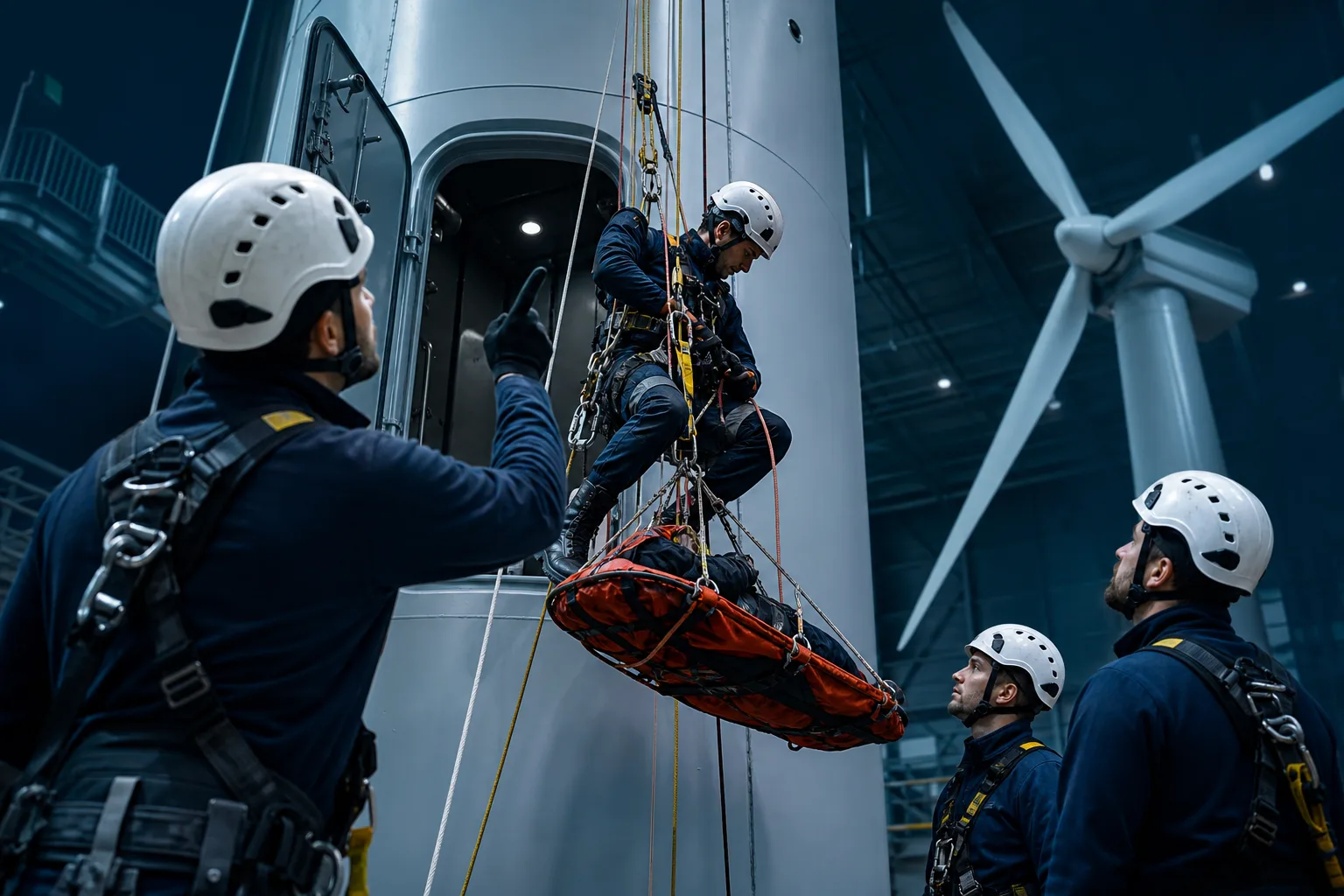
Recently, specialists from the EcoTEK company completed a course of advanced qualification training ARTR (Advanced Rescue Training Refresher Standard), which corresponds to the modern GWO standard. This educational module not only expands but also deepens professional knowledge previously acquired on the GWO Basic Safety Training course, adding complex skills and algorithms for conducting rescue operations at wind energy facilities using specialized equipment.
The course is divided into two main parts: theoretical and practical, each of which plays a decisive role in forming reliable rescue competencies.

Theoretical Block
• Incident Management - participants get detailed knowledge of organizing emergency situations, modern approaches to risk assessment and all necessary for competent guidance of rescue measures on the site.
• Site Incident Analysis - analytical skills are updated by determining potential threats and choosing the best rescue tactics considering all specific circumstances related to wind farm operations.
• Modern Rescue Equipment - attention is given not only to reviewing the use of already known types of equipment, but also to studying the latest updates on winches, tripods and stretchers, optimal for limited space and vertical movements.
• New Cable and Rigging Systems - the course updates knowledge about modern methods of lifting and lowering, knot tying, securing equipment and processing attachment points on towers and nacelles.
• Lifting Mechanisms, Mechatronics, and Winches - the principle of operation of lifting mechanisms and calculation of mechanical advantages during evacuation of injured persons are detailedly discussed.
• Safety in Enclosed Spaces - participants reacquaint themselves with rescue protocols inside turbines, thoroughly study the correct technologies for ventilation and evacuation during non-standard situations, track all recent changes in this field.
• Assessment of Victim's Condition - knowledge update on advanced diagnostic methods for injuries, including algorithms to provide assistance when there is a suspicion of spinal cord injury and other critical conditions that go beyond traditional first aid.
• Transportation of Victims - skills are enhanced for preparing people for evacuation inside turbines, new requirements to packaging and transport with consideration of current protocols are learned.
• Psychological Support - special attention is given to the ability to provide basic emotional support to victims, as psychological comfort significantly influences the outcome of a rescue operation.

Practical Block
• Simulation Exercises - participants immerse themselves in realistic rescue scenarios at wind installations, where they apply new knowledge and developments on rescue algorithms using current equipment. All actions take place under the supervision of experienced instructors.
• Development of Team Spirit and Communication - great attention is paid to improving collective work and developing skills for effective interaction within a rescue team in conditions of strict time and emotional constraints.
• Analysis and feedback — after each session, a review of errors is conducted and paths for further professional improvement are sought to ensure compliance with modern industry requirements.

The main task of the course is to deepen and update skills necessary for conducting safe and efficient rescue operations from a nacelle, tower, and basement of a wind energy installation based on advanced GWO standards. As a result, participants not only become professionals in rescue techniques but also confidently act in stressful and emergency situations.
Share: